


Hands Change: What Palmistry Knows Despite Its Reputation
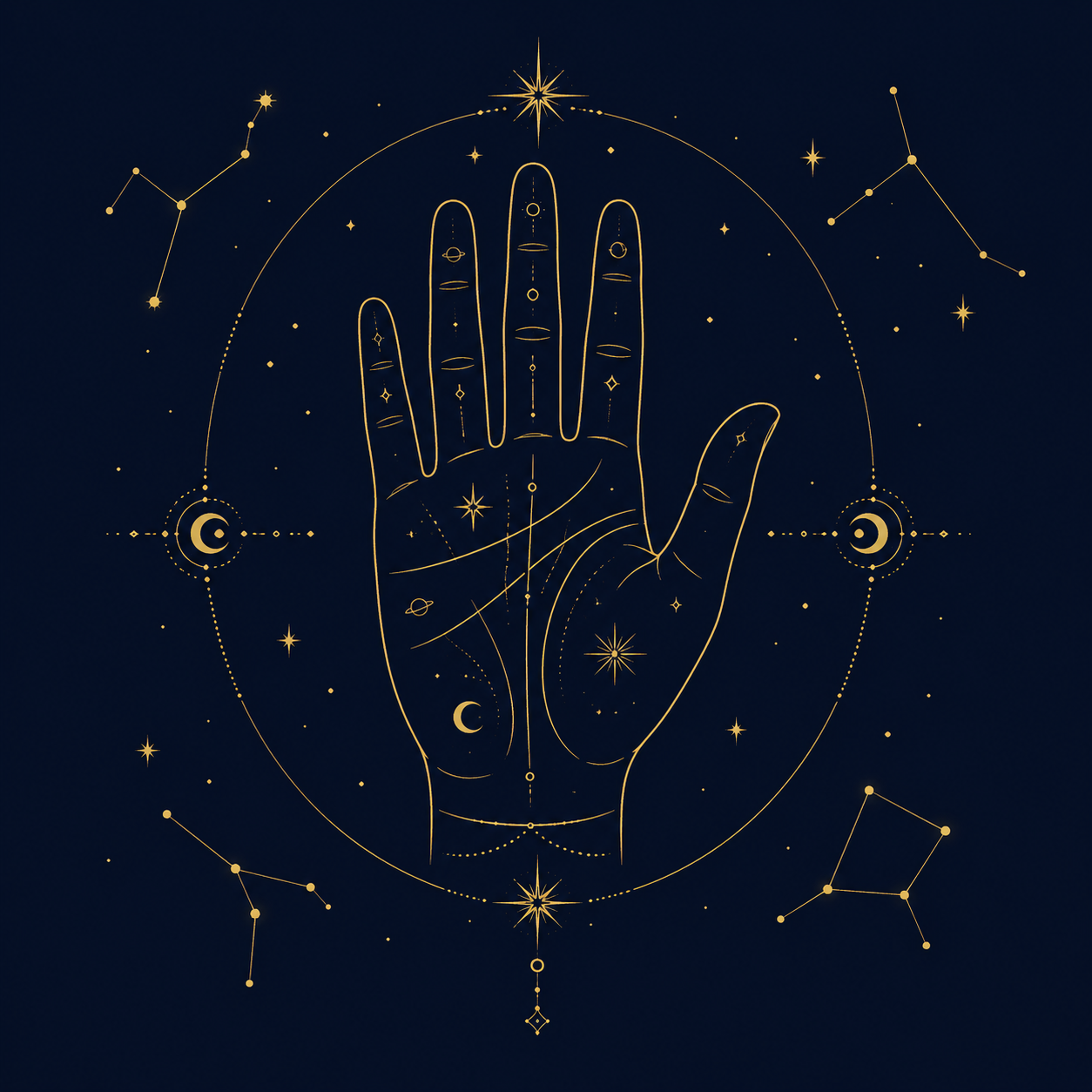
Palmistry from inside the craft: two branches, two hands, why the life line doesn't measure lifespan — and the tradition's real premise: your palm is a diary, not a sentence.
Every palmist with real years at the table has watched a client stare at their own hand as if it were a verdict. The oldest thing the craft knows — older than its reputation, older than the boardwalk booth — is the opposite: the palm is not a sentence passed on you. It is a diary you have been keeping without noticing.
A very old, very travelled art
Palm reading is among the oldest divination arts with a continuous history. Britannica traces its likely origins to ancient India, from where it travelled to China, Tibet, Persia, Mesopotamia and Egypt before flowering in Greece. The Greeks loved it enough to forge for it: a treatise on the subject circulated for centuries under Aristotle's name, complete with a legend that it had been found on an altar of Hermes — false attribution being, then as now, the sincerest form of prestige. Medieval Europe read palms in Latin; the nineteenth century made it a salon phenomenon, with the Irish celebrity palmist 'Cheiro' reading for Mark Twain and Oscar Wilde. A craft does not survive four thousand years of fashion cycles unless it touches something people keep needing.
Two branches, not one
What the reputation flattens, the tradition splits carefully in two. Chirognomy reads the hand's form — the shape of the palm, the length of fingers, the give of the flesh — and treats it as temperament: the broad practical square, the long-fingered analyst, the tapering dreamer. Chiromancy reads the lines. The distinction matters because the two speak on different timescales. Form is slow — closer to constitution. Lines are fast — closer to weather. A reader who conflates them will tell you your character is doomed by next spring, which is nonsense in both branches' terms.
The fact in the title
Here is the observation the whole craft rests on, and the one science agrees with: the major flexion creases are laid down before birth, but their depth, their branching, their fine tributaries shift over months and years of use — while your fingerprints, the true fixed signature, never change at all. Traditional practice encodes this in the two-hand rule: the passive hand is read as what you arrived with, the dominant hand as what you are doing with it. The gap between your two palms is the most honest sentence a palmist can read aloud — it is the distance between your inheritance and your effort. And this is why serious readers ask to see your hands again a year later. They are not checking their prediction. They are reading the next diary entry.
The myth that will not die
Say it plainly, because twenty-year practitioners say it in their first five minutes: the life line does not measure lifespan. No lineage of the craft — Indian, Chinese, Greek, European — ever taught that it did. It reads the quality and rootedness of vitality: how you inhabit your body, how you recover, how firmly your daily life holds you. A short, deep line is a concentrated life; a long, faint one is a scattered one. The lifespan myth is carnival shorthand that escaped into the culture, and it has frightened more people than any honest reading ever helped. A reader who leans on that fear is doing something the tradition itself calls malpractice — we wrote about the reader's duty to refuse in When the Reading Says No.
What a good reading feels like
A palm reading done inside the craft's own rules is strangely quiet. The reader looks at both hands, names the temperament the form suggests, reads the current weather in the lines — and then does the thing that separates craft from theater: asks you what you have been doing with your hands lately. Because the palm answers use. Grip, craft, tension, rest — it records them the way the coffee cup records attention, a kinship we explored in The Cup Remembers. The reading ends facing forward: if the diary's next entry is yours to write, what do you want your hands to be doing this year? That question — not the booth's velvet doom — is the craft's real inheritance, and it is the same faculty of honest attention we call The Quiet Sense.
The library teaches the craft. A reading applies it to you.
Get your personal reading